
There are plenty of places in the world that make an excellent holiday destination. There are rather fewer that can genuinely make a convincing case for becoming your home.
Phuket is one of them.
At first glance, the attraction seems obvious. Turquoise water, tropical beaches, warm weather, spectacular sunsets, palm trees, restaurants, resorts and an extraordinary choice of things to do. But if you look at Phuket only through the eyes of a holidaymaker, you miss what makes the island particularly compelling as an international relocation destination.
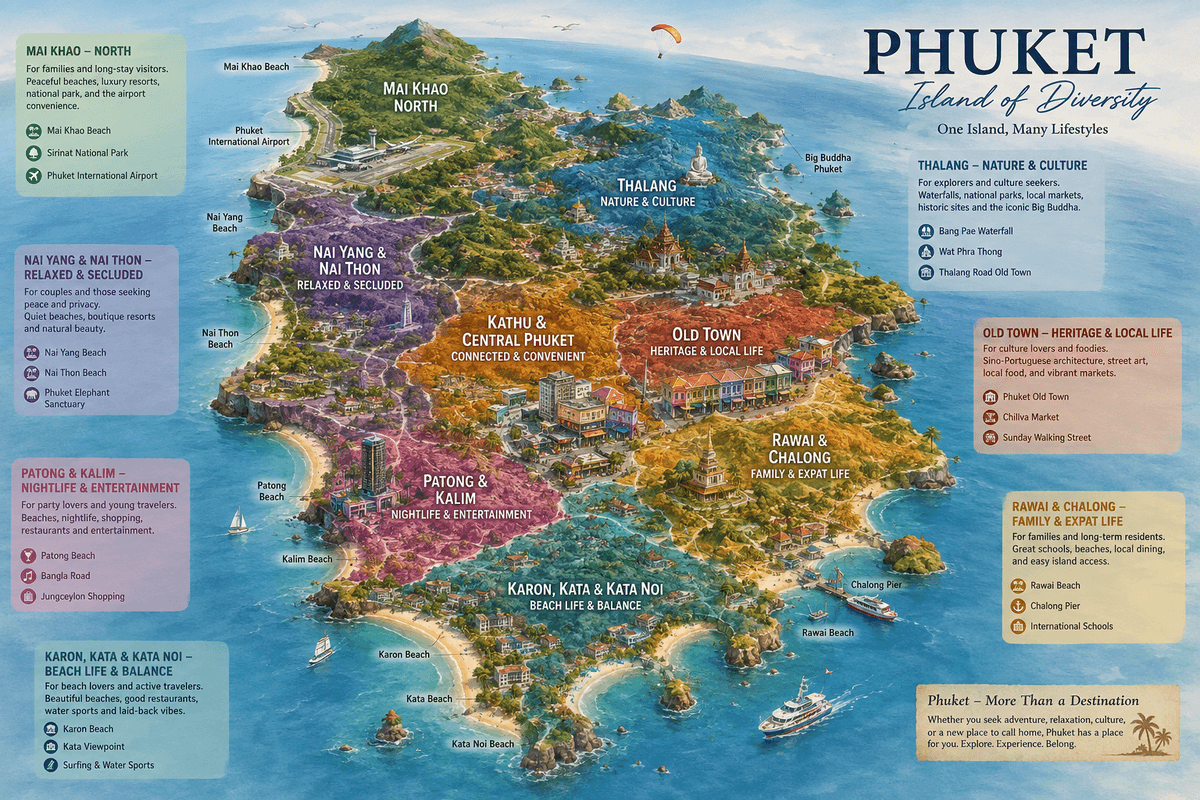
If you would like a free downloadable hi-res copy of this map, please click here (or send us an introductory email! david@prime-property-thailand.com
Phuket is not simply a tropical resort. It is a functioning, diverse and increasingly sophisticated community where people from all over the world have built businesses, families, careers, retirement lives and new chapters. It combines many of the pleasures associated with island living with infrastructure, healthcare, education, international connectivity, shopping, dining and services that make permanent life considerably easier than the postcard image might suggest. (Modern Expat Magazine)
And perhaps most importantly, there is no single version of Phuket.
That is the point beautifully illustrated by Phuket 101's recent advice to first-time visitors: Patong for energy and nightlife, Kata for balance, Kamala and Bang Tao for a more sophisticated resort lifestyle, Old Town for history and food, and Rawai and Nai Harn for a more relaxed southern rhythm.
For someone considering an international move, that diversity is not simply useful. It is one of Phuket's greatest strengths.
You are not really choosing whether you want to live in Phuket. You are choosing which Phuket you want to live in.
An island, but not an isolated one
One of the first things that surprises people who have only visited Phuket on holiday is how substantial the island actually is.
Phuket is Thailand's largest island and is large enough to contain dramatically different environments, communities and lifestyles. The west coast is lined with many of the beaches for which the island is famous, while Phuket Town provides a very different urban and cultural experience on the southeast side. The northern part of the island becomes progressively quieter, while the southern areas have developed their own established communities and international character. (Tourism Authority of Thailand)
That geographical variety matters enormously when you are considering a move.
A young professional may want restaurants, gyms, cafés, nightlife and a vibrant social scene. A family may prioritise schools, healthcare, supermarkets, space and a quieter neighbourhood. A retiree may want a beautiful beach, good restaurants and a relaxed community. A business owner may value access to the airport and commercial centres. Someone working remotely may want a villa, reliable internet, cafés and an international community without the pressures of a major city.
All of these people can find a version of Phuket that works for them.
That is a very different proposition from moving to a destination where the lifestyle is essentially determined by one small town or resort strip.

The beaches are only the beginning
It would be ridiculous to discuss Phuket without acknowledging its beaches.
They are, after all, extraordinary.
The island offers everything from lively and highly developed beaches such as Patong to quieter stretches such as Nai Thon, Nai Yang and Mai Khao, along with the much-loved beaches around Kata, Karon, Kamala, Bang Tao, Rawai and Nai Harn. The official Phuket tourism information lists a remarkable range of beaches across the island, while Sirinat National Park alone protects a substantial section of the northwest coastline, including beaches, coral reefs, forests and marine habitats. (Visit Phuket)
But for somebody moving here, the real luxury is not necessarily having a beach outside the front door.
It is having the freedom to make the beach part of ordinary life.
A morning swim before work. A sunset walk after dinner. An afternoon on the sand with the children. A weekend boat trip. A spontaneous decision to drive to a different coastline simply because you fancy seeing somewhere new.
When you live somewhere beautiful, those things stop being excursions and become part of your routine.
And because Phuket has so many different coastal environments, you can enjoy that lifestyle without having to accept the same atmosphere every day.
Patong: for those who want life around them
Patong is perhaps the most internationally recognised part of Phuket, and it is easy to dismiss it as simply the island's party capital.
That would be incomplete.
Yes, Patong is busy. Yes, it has nightlife. Yes, it is probably not the first choice for someone looking for complete tranquillity.
But for somebody who enjoys convenience, energy and having almost everything close at hand, Patong can make considerable sense.
Restaurants, entertainment, shopping, hotels, services and the beach are all concentrated into a relatively compact area. Phuket's own tourism information describes Patong as the island's principal entertainment and shopping beach, with extensive facilities. (Phuket)
For some people, that is exactly what they want.
Not everyone dreams of a secluded villa at the end of a quiet road. Some people want to walk out of their front door and immediately find cafés, restaurants, friends, shops and something happening.
Phuket can accommodate that personality too.
Kata and Karon: the middle ground
Then there are areas such as Kata and Karon, which occupy an appealing middle ground.
They offer beaches and a recognisably tropical lifestyle without necessarily having the intensity of Patong. They can suit couples, families and people who want to remain connected to the island's tourism infrastructure while enjoying a somewhat calmer pace.
This middle ground is important because relocation is rarely about finding the most luxurious, cheapest or quietest location.
It is about finding the right balance.
Perhaps you want the beach, but also a supermarket nearby. Perhaps you want restaurants, but do not need nightlife. Perhaps you want somewhere attractive enough to feel like a permanent holiday without feeling as though you are living inside a hotel district.
For many people, that balance is the sweet spot.
Kamala and Bang Tao: Phuket's more sophisticated side
Move north and another version of Phuket emerges.
Kamala, Bang Tao, Laguna, Cherng Talay and the surrounding areas have become particularly attractive to international residents looking for a more polished lifestyle.
Here, the emphasis is less on traditional nightlife and more on restaurants, beach clubs, wellness, modern residences, resort facilities and an increasingly international community.
Bang Tao and Cherng Talay in particular have developed into one of the island's most internationally oriented residential areas, with an extensive selection of restaurants, shopping, gyms, cafés, villas and condominiums. (Modern Expat Magazine)
For families, this part of the island can be especially attractive because the lifestyle can combine beaches and leisure with access to international education and everyday amenities.
For couples, it offers an appealing combination of sophisticated dining, wellness, beaches and social life.
And for property buyers, the area demonstrates another important characteristic of Phuket: the island is not dependent upon one type of property or one type of buyer.
There are luxury villas, resort residences, condominiums, family homes and more modest accommodation options, all serving different markets.
Old Phuket Town: character over coastline
Then there is Old Phuket Town.
This is where the argument that Phuket is simply a beach destination falls apart completely.
The historic centre has a character all of its own, shaped by the island's Chinese, European and other cultural influences and its history as a trading and tin-mining centre. Its distinctive Sino-Portuguese architecture, shophouses, cafés, restaurants, markets and historic streets create an atmosphere that feels entirely different from the resort areas. (Tourism Authority of Thailand)
For some people, this is the Phuket they fall in love with.
They want street food rather than room service. They want markets rather than beach clubs. They want architecture, history, independent cafés and neighbourhood restaurants.
And although Old Town is not on the beach, that does not necessarily make it less attractive for permanent living.
In fact, some people deliberately choose to live away from the resort coastline because they prefer the greater sense of everyday Thai life that can come with being closer to the island's administrative, commercial and cultural centre.
It is another example of why the question should not be "Where is the best place in Phuket?"
The better question is "What kind of life do I want?"
Rawai and Nai Harn: the established southern lifestyle
At the opposite end of the island, Rawai and Nai Harn offer another compelling proposition.
The south has long attracted international residents who prefer a more relaxed and established community atmosphere. There is a strong presence of long-term residents, independent restaurants, cafés, fitness businesses, marine activities and services catering to people who actually live on the island rather than simply visit it.
Nai Harn is particularly attractive for those who want beautiful surroundings without being completely immersed in a major resort centre.
Rawai, meanwhile, has its own distinctive personality. It is more practical, more local in places and strongly connected to Phuket's marine lifestyle.
For somebody moving to Phuket rather than taking a two-week holiday, that distinction can be significant.
A destination becomes much more attractive when you can imagine not merely visiting it, but building a routine there.
And then there are the places people don't talk about as much
One of the most interesting things about Phuket is that the obvious areas are not necessarily the only areas worth considering.
There are quieter communities inland and towards the northeast, areas around Chalong and Kathu, the airport and northern beaches, and numerous residential pockets where the atmosphere can change dramatically within only a few kilometres.
The northeast, for example, can feel much more local and tranquil than the west coast, while still providing access to beaches, marinas, nature and the rest of the island. (Modern Expat Magazine)
This matters because international relocation is not tourism.
When you move somewhere, your priorities evolve.
You discover the supermarket you prefer. You find the restaurant where everybody knows you. You work out which road to avoid at 5pm. You discover a quieter beach. You meet neighbours. You find a favourite coffee shop. You develop routines that never appear in a holiday brochure.
And suddenly the island becomes much bigger and much more interesting than the handful of places you initially knew.
A genuine international environment
Another major advantage of Phuket is its international character.
People from across Europe, Asia, Australia, North America and many other parts of the world have made the island home. That creates an unusual cultural blend in which international lifestyles exist alongside deeply Thai communities and traditions.
Thailand's Tourism Authority specifically highlights Phuket's multicultural heritage, including its strong Chinese influence and the many ethnicities and traditions that have contributed to the island's identity. (Tourism Authority of Thailand)
For someone moving overseas, this can make the transition considerably easier.
You can immerse yourself in Thai culture without having to abandon the familiar altogether.
You can eat Thai food one evening and Italian, Japanese, Indian, French or Middle Eastern food the next. You can join international sporting groups, social clubs, business communities or hobby groups. You can meet people who have lived on the island for decades alongside others who arrived last month.
That mixture can create a remarkably easy landing place for an international move.
The practical side matters too
Of course, nobody should move countries based purely on beaches.
The practical infrastructure matters, and this is where Phuket has a substantial advantage over many tropical destinations.
The island has an international airport, private healthcare, international schools, major shopping facilities, supermarkets, restaurants, fitness and wellness businesses, marinas and a mature service economy. It is connected to the mainland by road and has extensive domestic and international travel options. (Baanlyy)
That means you can have an island lifestyle without necessarily accepting an isolated lifestyle.
- Need to fly to Bangkok for a meeting? Easy.
- Want to travel elsewhere in Southeast Asia? The airport makes that practical.
- Need specialist medical care? Phuket has established private healthcare facilities.
- Have children who need an international education? There are established international schools.
- Want a modern shopping centre? There are several.
- Want local markets and traditional Thai food? They are everywhere.
- Want a luxury restaurant? There is no shortage.
- Want to spend the afternoon somewhere that feels completely untouched by modern tourism? Those places exist too.
That combination is unusually powerful.
It is not perfect — and that is important
An unbiased case for moving to Phuket should also acknowledge the compromises.
It is not the cheapest place in Thailand.
Popular areas can be expensive, particularly for high-quality accommodation and property. Traffic can be frustrating, especially during busy periods. The island's popularity means that some locations become extremely busy during high season. The rainy season can bring substantial rainfall, and anyone considering a permanent move needs to experience Phuket outside the postcard-perfect dry-season conditions.
And while Phuket has excellent infrastructure by tropical-island standards, it is still an island. Transport is an important consideration, and your choice of neighbourhood can have a major effect on your daily routine.
These are not reasons not to move.
They are reasons to visit first, stay for a meaningful period, explore several areas and understand what everyday life actually feels like.
In other words, approach Phuket as a place to live rather than simply a place to holiday.
The real luxury is choice
Perhaps that is ultimately why Phuket works so well for such a diverse international population.
- It does not force everyone into the same definition of paradise.
- Paradise can mean waking up beside the sea.
- It can mean having a modern villa surrounded by tropical greenery.
- It can mean walking through Old Town with a coffee in your hand.
- It can mean taking the children to school before heading to the beach.
- It can mean working remotely from a café.
- It can mean sailing around the Andaman Sea.
- It can mean playing golf, training Muay Thai, diving, cycling, eating, travelling, socialising or simply doing very little.
- It can mean a lively nightlife or an early morning swim.
- It can mean luxury.
- It can mean simplicity.
- It can mean being surrounded by international residents, or living somewhere where Thai life feels much more dominant.
Phuket can accommodate all of those things.
And that is why the advice from Phuket 101 is so relevant to anyone considering a move. There really is no single "best" area.
There is only the area that best fits the life you want to create.
From holiday destination to home
There is a significant psychological difference between choosing somewhere for a holiday and choosing somewhere to live.
On holiday, you ask: "Where should I stay?"
When relocating, you ask: "Where can I build a life?"
That second question changes everything.
You start looking at schools, healthcare, transport, communities, supermarkets, property, restaurants, beaches, work opportunities, hobbies, social networks and the little details that make everyday life enjoyable.
And once you begin looking at Phuket through that lens, the island becomes much more compelling.
It is not simply a tropical playground.
It is a place where a family can establish roots, where a couple can start a new chapter, where a retiree can enjoy a more relaxed lifestyle, where an entrepreneur can build a business and where an internationally minded individual can create a life that combines the familiar with something genuinely different.
Perhaps that is the greatest attraction of all.
Phuket does not promise one perfect lifestyle.
It offers the opportunity to design your own.
And whether your ideal version of island life is found in the energy of Patong, the balance of Kata, the sophistication of Bang Tao, the character of Old Town, the relaxed southern atmosphere of Rawai and Nai Harn, or somewhere quieter that you have yet to discover, there is a very good chance that somewhere on this island, your version of Phuket is waiting for you.
For anyone contemplating an international move, that is a pretty compelling proposition.
Because sometimes the best destination is not the place that gives you one perfect answer.
It is the place that gives you the freedom to choose.